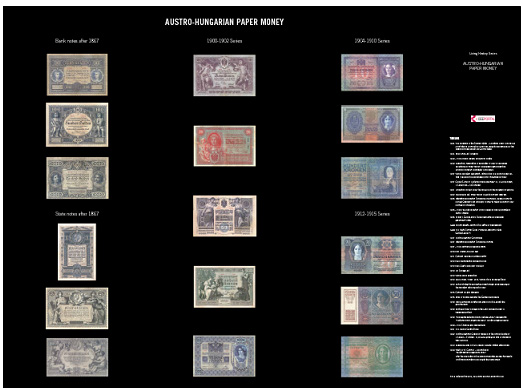
The
poster shows the particularly beautiful banknotes (Gulden
and Kronen) from the period between 1867 and 1918. Since the
foundation of the “privilegirte österreichische
National-Bank” in 1816 numerous famous Austrian artists,
such as Koloman Moser, Gustav Klimt, Ferdinand Kitt and Berthold
Löffler, have designed banknotes for the Austrian National
Bank. The poster also includes a timeline for those interested
in the historical context.
Size: 91 x 68 cm / 35,5 x 26,5 inches
Condition: New/Original
Timeline:
1834 The Zollverein of the German States - A customs union
is formed as a first step in unifying the currencies, weights
and measures of the previously independent 39 German states.
1844 Peel’s Bank Act (England)
1848 – 1916 Francis Joseph, Emperor of Austria
1848 Revolution, redemption of banknotes in silver is suspended.
Acceptance of paper money is declared a legal obligation.
Emission of money substitutes is forbidden.
1857 Vienna Monetary Agreement: Introduction of a uniform
silver currency, based on the exchangeability of banknotes
for silver.
1857 Gulden Currency („österreichische Währung”
11,11 g fine silver), 1 Gulden öW = 100 Kreuzer
1861 Unification of Italy under the influence of the Kingdom
of Sardinia.
1862 Plener Bank Act: Paper money linked to currency reserves.
1865 International Monetary Conference in Brussels: devises
a plan to combat Gresham’s law problems in order to
retain subsidiary silver coinage in circulation.
1865 – 1926 The Latin Monetary Union (based on France’s
bimetallic metric system)
1866 In May 1 Gulden and 5 Gulden banknotes are declared government
notes.
1866 Prussia defeats Austria at the Battle of Koeniggraetz
1866 K.K Staats Central Casse (“Imperial and Royal State
Central Cashier”)
1867 Austro-Hungarian Compromise
1867 International Monetary Conference in Paris
1867 – 1918 Austrian-Hungarian Empire
1870-1871 Franco-Prussian War
1871 Germany becomes a united country
1873-1924 Scandinavian Monetary Union
1873-1886 Great Depression in Britain
1873 US Coinage Act
1873 Vienna World Exposition
1873 Black Friday, 9 May 1873, Vienna Stock Exchange Crash
1873 British strategy to demonetize silver through an overvaluing
of the monetary ratio of gold to silver.
1875 Germany on gold standard
1875 Bank of Prussia becomes the German Reichsbank
1878 France abandons bimetallism and in practice adopts the
gold standard
1878 Minting of silver coinage in the Latin Monetary Union
is suspended entirely.
1878 “Privilegirte oesterreichische National-Bank"
changed into “Oesterreichisch-ungarische Bank"
(Austro-Hungarian Bank)
1880 – 1914 Classical gold standard era
1881 K.K. Reichs Central Casse
1892 Austro-Hungarian Gulden is replaced by the Krone at a
rate of 1 Gulden = 2 Kronen. 0,304878 g fine gold with a fineness
of 900 per mille
1913 Federal Reserve Act (US Federal Reserve System established)
1919 Treaty of St. Germain – Liquidation of “oesterreichisch-ungarische
Bank”
After the dissolution of the empire banknotes are overstamped
to limit their circulation according to the new borders.
|